WEEK 9
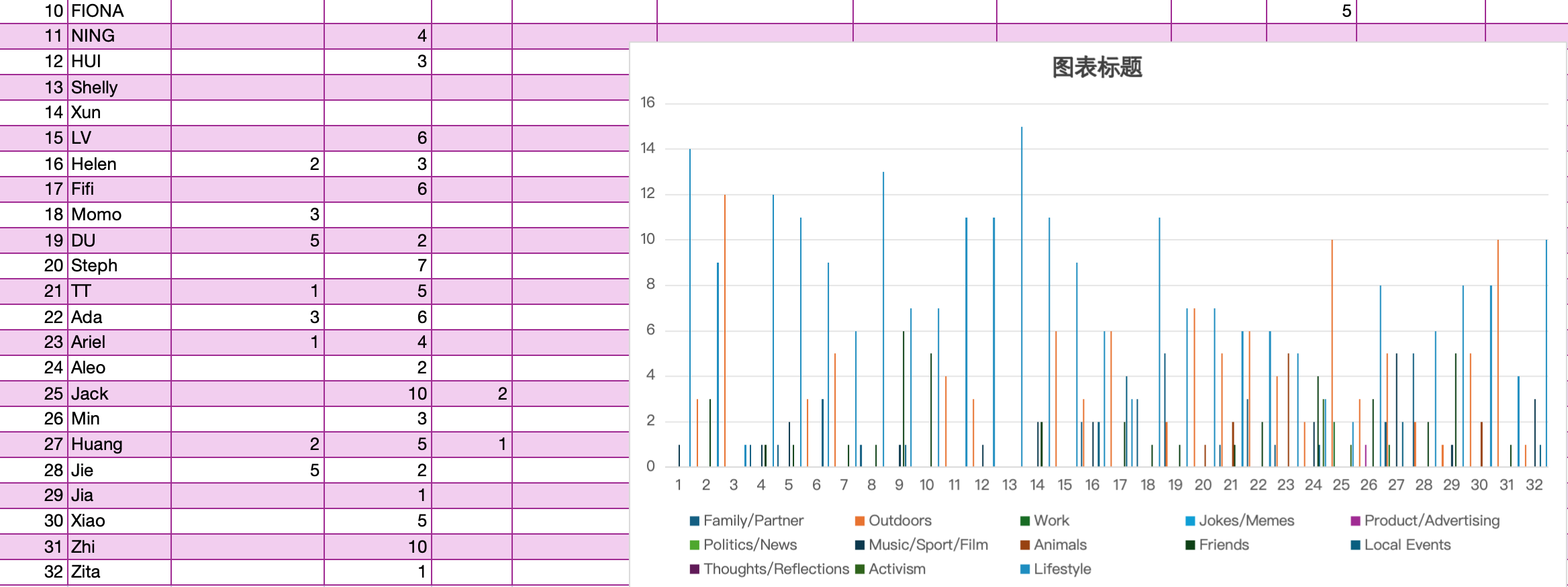
Last week, following Sumpter's method, I identified 32 friends on social media and categorized their most recent 15 posts into specified category lists. I compiled the results into an Excel spreadsheet and created bar charts to visually display the outcomes. During the categorization process, I encountered some uncertainties. For example, a single photo could fall under multiple tags. In cases like selfies taken during outings, I categorized them uniformly as "lifestyle" rather than "outdoor."
From the data analysis in this project, I observed that my female friends predominantly shared selfies and scenic photos, while male friends preferred posting about sports events or fitness activities. However, Sumpter's method cannot accurately represent my friends' online identities due to the relatively small dataset and sample size. Nevertheless, it provides an initial understanding of a user's preferences.
In class, we also participated in an engaging Partner Activity. This discussion significantly broadened my knowledge base. I discovered some communities I had never heard of before and delved into their posts to explore the content. Everyone has different interests, and these communities provide a quick way to understand a person’s preferences. It made me marvel at how powerful and convenient information collection has become today.
However, each community has its own rules, and to engage meaningfully within them, one needs to understand and follow these guidelines. While there are many differing opinions in the comments, most are relatively positive. This suggests that freedom of speech is largely grounded in ethical and social norms, reminding us that the internet is not a lawless space.